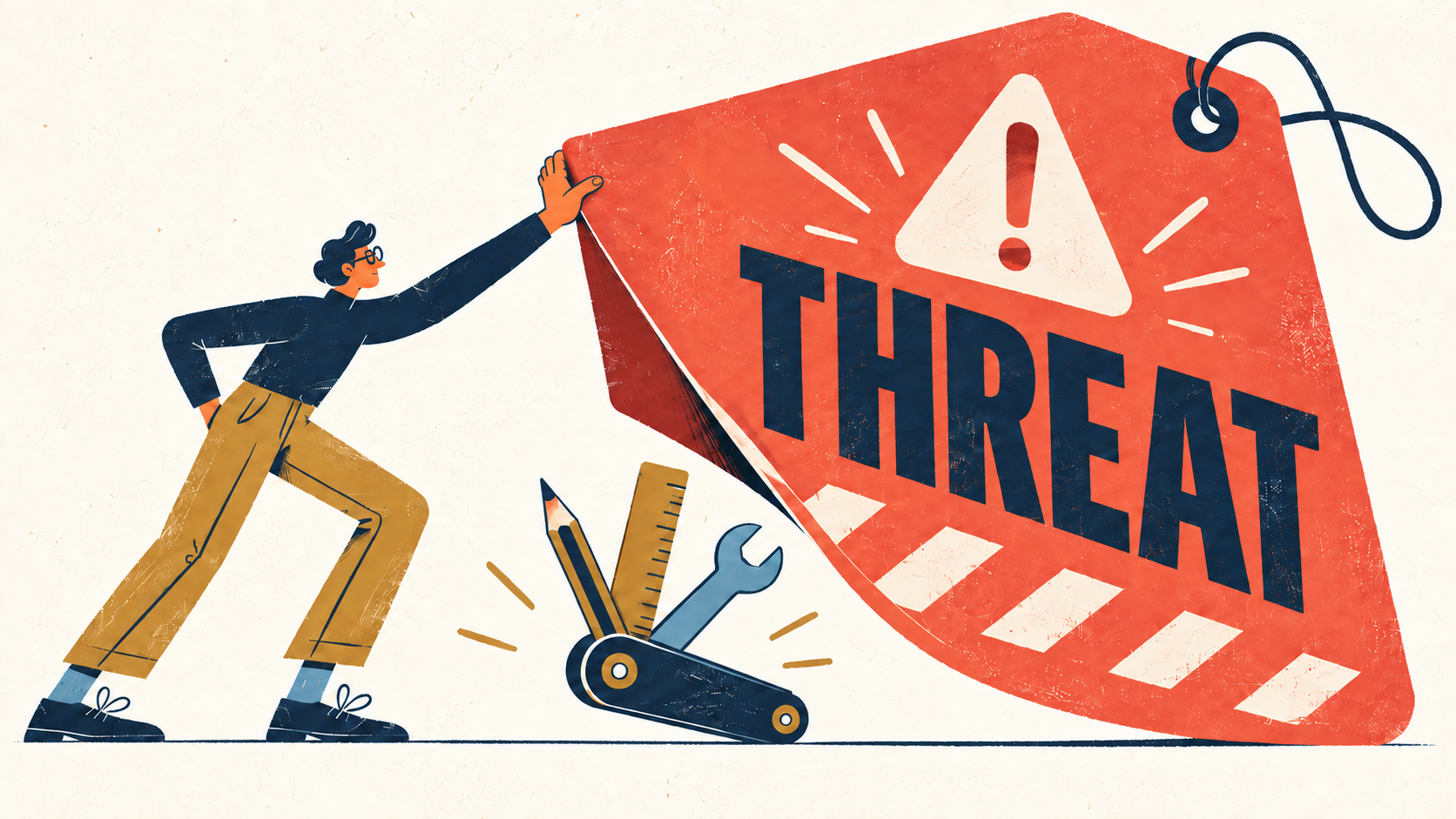
AI has a branding problem.
We have been handed the most transformational technology of our lifetime and have greeted it, as we do so often these days, with an endless procession of existential crises. Leaders of the frontier labs have made many communication missteps as their companies have scaled at a rate the market has rarely, if ever, seen. The media is flooded with stories about job loss, geopolitical conflict, and even human extinction within a decade.
None of that framing captures what I have experienced with the technology.
What I have experienced is a tool that changes the distance between an idea and execution. You can take a messy thought, describe it vividly, and turn it into a prototype within an hour. Random thoughts are contextualized and structured in a way that allows your mind to expand the scope of consideration. You quickly begin to address problems that you weren’t anticipating and prepare for scenarios you hadn’t yet considered.
When AI is working well, problems begin to feel like puzzles. Work is connected without feeling overwhelming. The technology feels less like another system that you’re forced to wrestle with and more like a partner in a build.
One of the biggest discoveries for me in working with AI is that it does not simply address the question that I asked. It guides me toward better questions, which lead to a more complete solution than the one I initially imagined.
The expansion of the scope of work is met with a powerful sense of agency. Ideas that would have required a contractor, a specialist, a significant budget, or weeks/months of meetings are suddenly within reach. You are only limited by your own curiosity. And potentially token consumption, as I’ve found out! You can make a first pass, study the result, provide a tough critique, and produce a functional model before the old process would have assembled for a kickoff call.
You begin to look beyond the boundaries of what you thought you were capable of accomplishing.
This doesn’t mean expertise is becoming irrelevant. Judgment is essential. Taste will differentiate you.
AI can make almost anything. That does not mean everything deserves to be made. Today’s models already possess enough technical reasoning to sit alongside most, if not all, senior professionals. We are no longer waiting for the technology to improve to provide real value to the work. The opportunity is not to insert AI into the way we already work, but to redesign the work around what it now makes possible. The skill that differentiates professionals is learning how to point that capability appropriately at the right problem.
My mantra since diving headfirst into the technology is that curiosity is the #1 quality required to do great work. A technical pedigree is not required. I couldn’t write one line of code when I started this pursuit, and I still can’t today.
Intellectual curiosity and a genuine desire to solve problems are a lethal combination. Some of the most advanced skills and models that I have built at work were built in partnership with first-year analysts and summer interns. Their ability to look at a problem in a new or different way and learn a new process through a condensed and organized study provides immense value in building production-grade work.
AI will not eliminate the role of the analyst of a thriving organization. AI will enhance the work the analyst is able to do, and automate the mundane, low-value tasks. A fresh set of eyes with an AI-native education adds real value to an organization that may be too comfortable doing things the way they always have.
Dario Amodei, the CEO of Anthropic, warned that AI could eliminate half of entry-level white-collar jobs within one to five years. I am not one to underestimate the technology, but I believe that framing is misguided. AI will eliminate some jobs. It will automate tasks of some entire departments. It will also raise expectations for what one person can accomplish.
AI is not coming for your job. AI is coming for parts of your job. This provides us with an incredible opportunity to decide which parts of our work are genuinely valuable. AI will absorb more of the rote work. Data transcription, initial research, and the endless movement of information from one location to another. How many analyst hours have been burned reformatting a PowerPoint or adjusting logos on a screen for an internal meeting?
This will provide people more time to exercise judgment, build relationships, understand customer needs, make decisions and solve consequential problems.
Jobs will change. Some will disappear. New roles will emerge and existing roles will become more ambitious because the standard of execution will be higher.
Those who lean into the technology will have a tremendous advantage. They will work faster, explore further, and solve problems that were previously out of reach. Organizations should prepare for this reality by empowering their people with the technology rather than looking for a digital replacement.
A workforce of 1,000 capable, curious, AI-fluent employees will outperform a 100-agent bot farm managed by a handful of executives all day long.
Technology scales the limits of what is possible. People must provide direction, judgment, accountability and context. Those qualities are imperative to great work.
The customer experience will matter more than ever. Human presence will carry more weight. In-person events, real conversations, physical spaces and tangible objects will tilt the competitive balance. As parts of work become frictionless, people will look for texture, character and grit elsewhere.
Hardly a day goes by without reading about a new existential threat from AI. I am not dismissing the geopolitical risks and bad actors that pose a legitimate threat to our wellbeing in some situations. There is a significant gap between a model that could potentially disrupt world order and the models that sit in our offices today.
The technology in front of us is already profound. We are still discovering new and meaningful ways to put that capability to work.
I have lost count of the number of “holy shit!” moments that I have experienced since fully investing myself in learning the technology. When an idea works, a barrier disappears, and the technology reaches beyond the boundaries of what I thought I could execute. Success compounds. Each bit of progress moves the edge of what feels possible a little farther out.
I started OneShotLens because I believe that there is an extraordinary opportunity to learn and grow alongside this rapidly advancing technology. The technology is too powerful to be a fad, too useful to remain a novelty, and too important to be understood only by the people building the models. I want to understand the technology, participate in it, and help others discover what becomes possible when they approach the learning curve with curiosity instead of fear.
OneShotLens is a living experiment in testing what is real, ignoring the noise, and sharing what I learn in a thoughtful way. I believe that the future is proof of work. You no longer need to tell someone what you can do. You can show them.
Beneath all the noise is a simple and optimistic idea:
AI does not replace human ambition. It expands our room to run.
I am not going to sit back and watch the future arrive from the sidelines.
Will you?